
Designing For TV
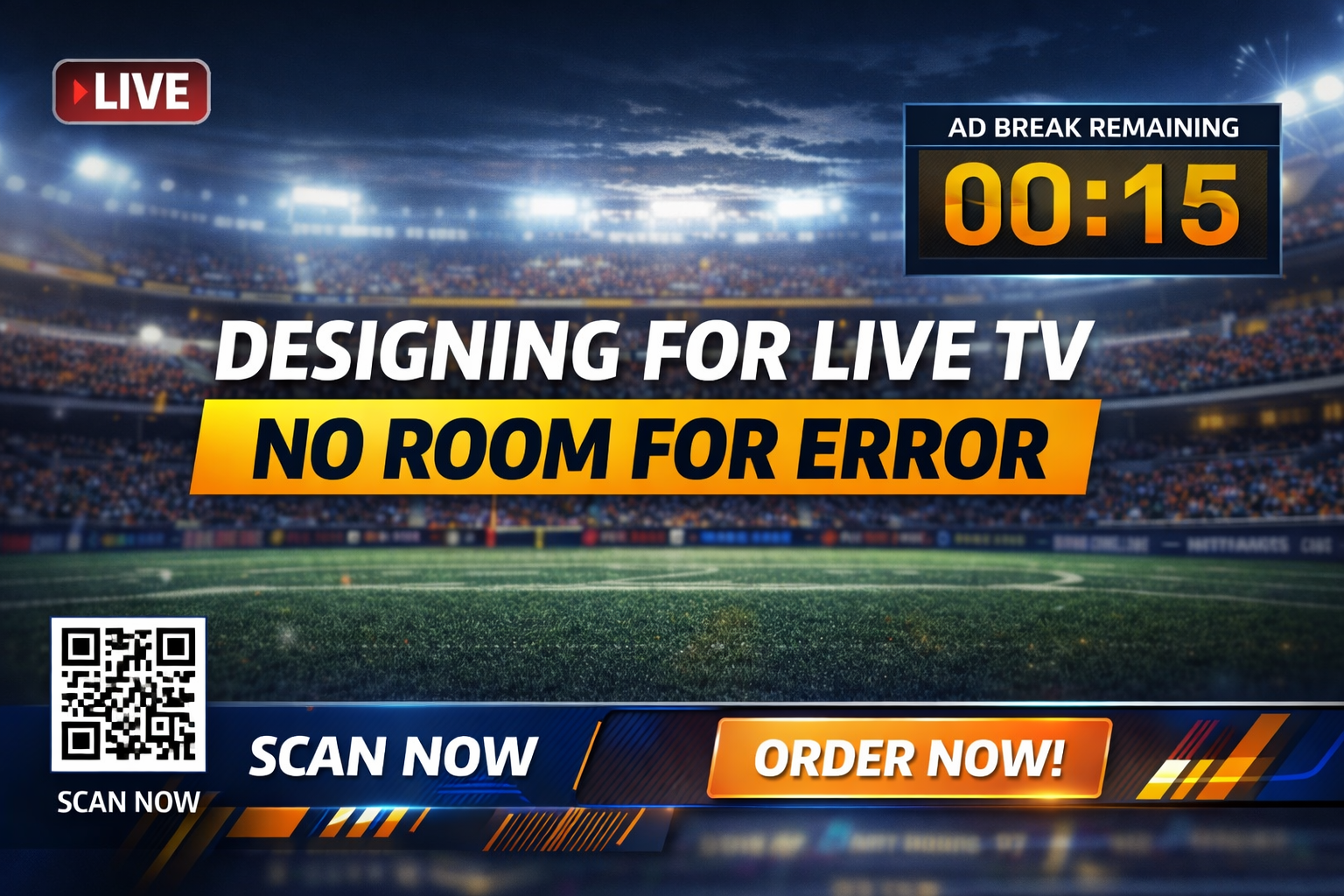
Created By OpenAi
Live sports advertising adds to the already intense pressure of live television. Viewers pay close attention to what is happening on the playing surface and are emotionally invested during a game. An advertisement has just a few seconds to grab viewers' attention before they check their phones, chat with others, or change the channel when a commercial break starts. Sports ads don't allow for design errors.
Viewers attention is a major design challenge for live sports television. Advertisements are in competition with the game itself, not with other advertisements. A design instantly loses impact if it appears slow, complicated, or unclear. Successful sports advertisements, according to Adweek, typically use intense images and fast cuts to keep viewers' attention throughout a game. https://www.adweek.com
Readability speed is another important consideration. In order to reread a message or understand complicated designs, viewers need to pause a live broadcast, which is often not a possibility. Fonts need to be instantly readable, even when seen from a distance on larger screens, therefore sports advertising is dominated by bold, condensed typefaces. In order for viewers to know where to look first, the design has to clearly show hierarchy. Organized visuals provide simplicity even during fast commercial transitions, as shown by networks such as ESPN and NBC Sports. https://www.espn.com, https://www.nbcsports.com
Additionally, timing is crucial. During sporting events, commercial breaks are planned according to the flow of the game. Within tight time constraints, designers must take into account how an advertisement starts and ends. Every second counts. Without wasting visual space, motion graphics are planned out to direct attention from the headline to the call-to-action. In sports advertising, motion serves as a useful tool rather than being decoration. Motionographer and other industry platforms regularly point out how motion design influences pacing and audience engagement in broadcast settings. https://www.motionographer.com
The elevated emotional state of the audience is also beneficial for sports advertising. Bold and vibrant visual messaging is more likely to be received by fans who are already involved in a close game. Ads must, however, feel consistent with the broadcast's tone because of the same level of emotion. A design that is too slow or subtle may seem disconnected from the actual game. In order to maintain consistency, effective sports advertisements use quick transitions and strong visuals that follow the game's pacing.
Finally, there is no chance for correction. Live sports advertisements are broadcast in front of millions of people in real time, unlike online ads that could be changed after they are released. An unclear message, a poorly timed animation, or a design flaw are all immediately seen. Before posting it live, designers are pushed by this pressure to carefully simplify, test, and improve their visuals.
What really counts in graphic design is revealed when designing for live sports television. Motion, hierarchy, timing, and clarity are not optional, but are necessary. Effective design does more than just looking good in a setting where viewers must make quick choices about what to focus on. It works well under pressure.

A collection of my observations as a designer, breaking down the small details, trends, and creative choices I notice in sports, media, and digital design.
