
Working Under Pressure
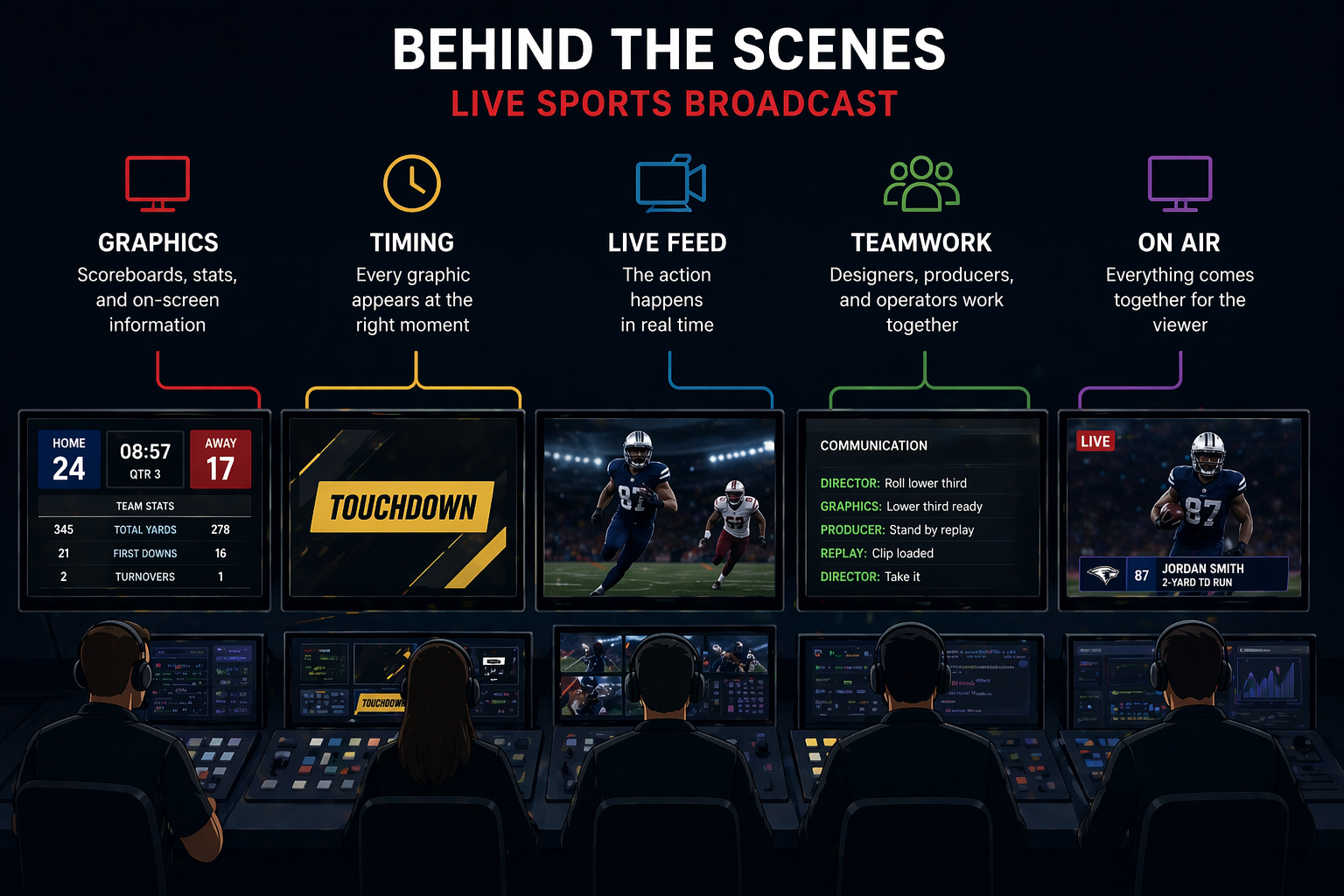
Created By OpenAi
While attending a live sports event, it is easy to concentrate only on the game itself. However, after becoming aware of the design processes used for broadcasting, it becomes apparent that there is a lot going on simultaneously off-screen. Animation, transitions, advertising, and data management are just some of the things that are being handled in real time. This is not left up to chance – it is all done with forethought and under great pressure.
First of all, it is interesting to see the amount of preparation that goes into designing a sporting event. Prior to a broadcast taking place, a design team will have already developed an entire graphics system. Scoreboard displays, lower thirds, stats templates, and promotional displays are just some of the things that need to be designed before an actual game begins. Templates ensure that the designer and operator can update the information while the game takes place without the necessity of creating something new.
In the course of the game, the focus turns to timing. The graphics do not get put up randomly; they are strategically timed with the activities taking place on air. For instance, a lower third may be displayed immediately after an exciting play, while a stat graphic will pop up immediately after a replay. On closer observation, I realized that all these were timed deliberately. There are no interruptions in the flow of the game; rather, graphics work to enhance its progress.
In addition, there is a close relationship between the design and the live data updates. The statistics, players, and scores need to be kept up to date at all times and in real time as well. As such, this puts additional pressure on designers as they need to make sure that their designs are not only aesthetically pleasing but functional.
A critical step in the process is coordinating as a team. The designer does not act alone; he or she is part of an entire production team that involves the producer, director, and technicians. Coordinating as a team is essential since the designer works according to what the production team dictates, and this involves having the graphic at the precise time when it is expected. As a result, broadcasting becomes an interactive process, which incorporates design as one of its aspects.
What I like most about this process is how all the pressure results in simple but effective design. No additional design elements can fit into the process due to limited space and time required for the job. Therefore, it becomes easy to understand how sport graphics appear through analyzing various broadcasts with the knowledge acquired.
As I continue to analyze sports broadcast design, I can see that design requires preparation, timing, and teamwork. What looks spontaneous on TV has really gone through a process of planning and implementation that has worked at the right time. It happens in an atmosphere where there is no room for redoing anything, and therefore design is more about doing things accurately than experimenting. In the world of sports broadcast design, graphic design is all about getting everything just right.
A collection of my observations as a designer, breaking down the small details, trends, and creative choices I notice in sports, media, and digital design.
